Fencing contractors for Surrey and north Hampshire
Fence installers who build to your garden, not to a fixed panel size. Closeboard, panel, slatted, composite, trellis, post and rail, acoustic and security fencing, on concrete posts and gravel boards unless you ask for timber.
What we fit
Pick by how much privacy you want, how much wind the line takes, and how much you want to paint it later.
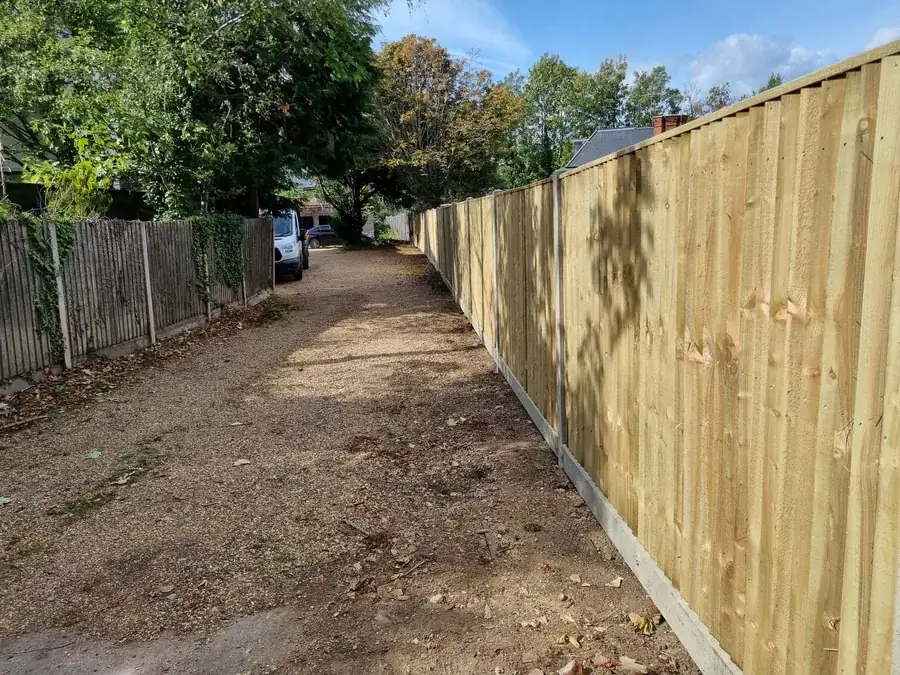 Closeboard fence, finished
Closeboard and feather edge
Featheredge boards fixed one at a time on site, each one overlapping the last, on rails between concrete posts. The strongest timber fence we fit, and the one for an exposed boundary. Add a capping rail along the top and rain runs off the board ends instead of soaking in.
Ask about closeboard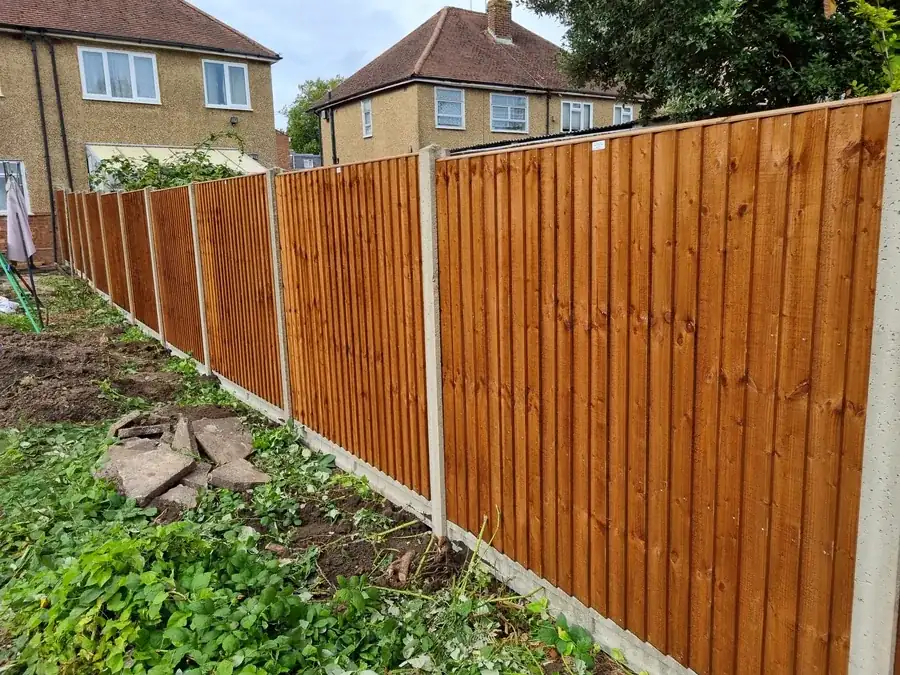 Panel fence between concrete posts
Panel fencing
Ready-made fence panels fitted between concrete fence posts. The quickest and usually the cheapest way to close a boundary.
Ask about panels Slatted fence, horizontal boards
Slatted, hit and miss and venetian
Narrow boards with an even gap, set upright or across, in hit and miss or venetian styles. Good garden screening that lets the wind through instead of fighting it. Also made in composite if you never want to paint it.
Ask about slatted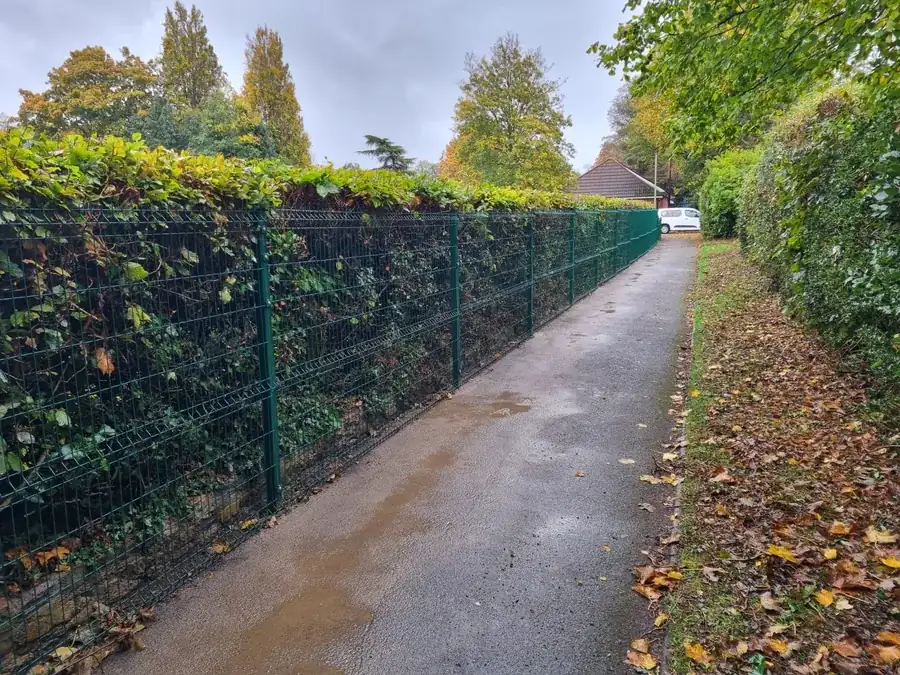 Mesh fence on steel posts
Mesh, weldmesh and security fencing
Welded steel mesh panels on steel posts, with gates to match. For long boundaries, woodland edges, footpaths and yards that need to stay secure. You can see through it, and a hedge will grow up through it.
Ask about mesh fencing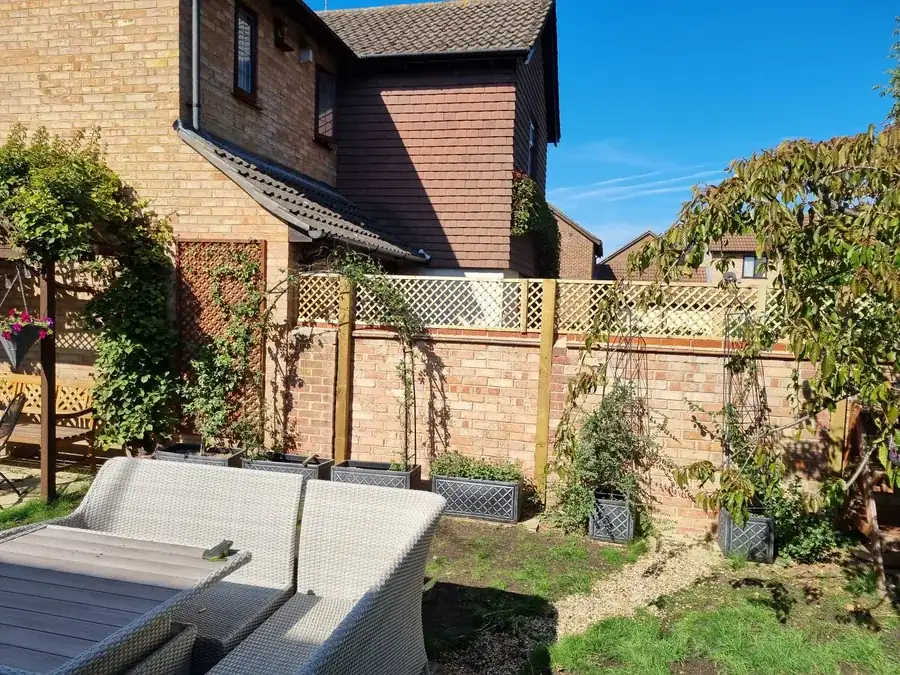 Trellis on a garden wall
Trellis and picket
Trellis along the top of a wall or an existing fence, for more height and privacy without a solid wall of timber. Low picket fences for front gardens too.
Ask about trellis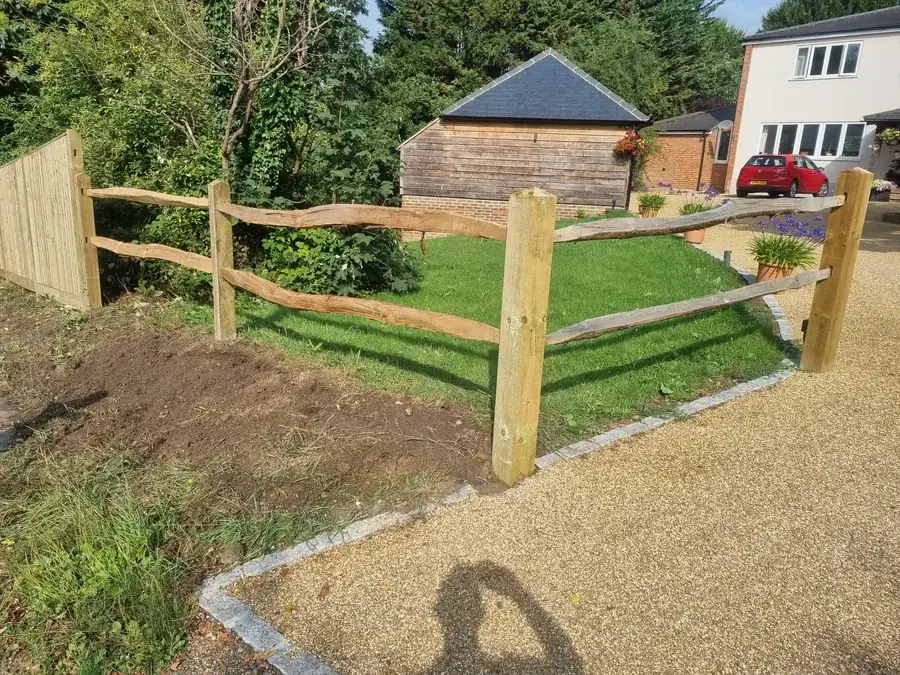 Post and rail along a bank
Post and rail, paddock and stock fencing
Sawn or split cleft rails for paddocks, field edges and country gardens, with stock fencing, rabbit wire fencing or deer fencing added where something needs keeping in or out.
Ask about post and rail
Built to the garden, not ordered to a size
A closeboard fence is not delivered. It is set out and built on site, one board at a time, which is what lets it fit a garden that is not a neat rectangle.
Set out before anything goes in
We measure the run and divide it so every bay comes out equal. No skinny offcut bay at the end where everyone sees it.
It follows your ground
On a slope, boards are cut to the fall instead of stepping down and leaving triangles of daylight underneath.
Any height you need
Including dropping down where a boundary does, or going taller on the one side you want screened.
Around whatever is in the way
A tree, a manhole, a curve in the boundary, or running tight up to a wall or a shed.
Matched to what is already there
Send a photo of the existing run and we will tell you what it is and whether we can carry it on.
Mended board by board
When something hits it you replace the damaged boards, not a whole panel. Cheaper every time it happens.
What makes one fence last longer than another
Three things, and only one of them is the part you can see.
The post
Concrete does not rot. A timber post in soil has a clock on it from the day it goes in.
The bottom board
A concrete gravel board holds your timber clear of wet ground. Swap it in twenty years without touching the fence.
The hole
Deep enough, and set in concrete. A shallow post moves in the first real gale and never goes back.
The timber
Pressure treated, so the preservative is in the wood rather than painted on the outside.
Closeboard fencing cost per metre, and why we price on site
It is the first thing everyone asks. An honest answer needs a look at the garden, because two fences of the same length can be very different jobs. A price given over the phone is either padded to cover what nobody has seen, or topped up on the day. We would rather come and look, then give you a written price that does not change.
Length and height
Metres are only half of it. A 1.8 metre fence and a 2 metre fence take different posts.
The ground
Clay, chalk or sand, and whether a slope means the fence is stepped or raked.
What has to come out
The old fence, old concrete round the posts, roots and stumps.
Access
A side path to work from, or everything carried through the house.
Posts and boards
Concrete or timber posts, gravel boards, capping, and the boards you pick.
Gates and extras
A matching side gate, trellis on top, or a step in height along the run.
The visit is free. We measure, check the ground and the access, and give you one fixed price for the whole job: materials, fitting and clearing the old fence away.
Questions we get asked
How long does it take to replace a fence?
Most garden fences are one or two days. A long run, a difficult access or a lot of old concrete to dig out can push it to three.
How long does a fence last?
A timber fence on concrete posts and gravel boards lasts far longer than one on timber posts, because the parts that rot first are kept off the ground. A fence on timber posts set in soil often starts to lean within a few winters. Composite lasts longer again.
What is a featheredge fence?
Featheredge boards are thick on one edge and thin on the other, and are fixed upright so each one overlaps the next. A closeboard fence is built from them, which is why the two names are used for the same fence.
What are gravel boards for?
A gravel board runs along the bottom of the fence, between the posts, so the timber boards stay clear of wet soil. Ours are concrete, so the part that sits on the ground cannot rot.
Do you use concrete posts or timber posts?
Concrete as standard, with a concrete gravel board at the bottom. Timber posts rot where they meet wet soil, and that is where most fences fail. We will fit timber posts if you ask for them, but we will tell you what we think first. The one exception is an acoustic fence, which is built all in timber, posts included.
How tall can my fence be?
In England, 2 metres at the back and sides. 1 metre if the fence is beside a road that cars use, or beside its pavement. No planning permission is needed up to those heights. Listed buildings are different. In a conservation area you may need permission to take an old fence down. There is a full explanation on our advice page.
Do you take the old fence away?
Yes, and it is in the price. Your quote is one price for the whole job: the materials, the fitting and clearing the old fence away. Nothing is added on the day.
Do acoustic fences work?
Yes, when they are built properly. An acoustic fence is heavier and more solid than a garden fence, with every board fixed tight so there is no gap for sound to come through. We build and install them all in timber, posts included.
Can you match the fence my neighbour has?
Usually. Send a photo when you ask for a quote and we will tell you what it is and whether we can match it.
Which side gets the smooth face?
There is no law on this. By convention the posts and rails face the owner of the fence, and the flat side faces the neighbour. Most people follow it, but it is your fence and your choice.
Do you need to come through the house?
Not if there is side access. We work from the garden. If the only way in is through the house we will say so at the quote, so there are no surprises on the day.
What happens to the plants growing on my old fence?
Cut back anything growing along the fence line before we arrive, or tell us and we will price it in. Climbers and trellis slow a job down more than people expect.
Will my garden be open overnight?
On most gardens the new fence goes up the same day the old one comes down. On a long run we close the gap each evening. Tell us if you have a dog or small children and we will plan the order around it.
How much does a new fence cost?
Every new fence is priced on the garden in front of us: the length, the height, the posts, the ground, the access and what has to come out first. That is why we give a free survey and a written quote instead of a guess, so the fence installation cost you agree is the one you pay.
Do you offer a free fence survey?
Yes. A fence survey is us coming out to measure the run, check the ground and the access, and see what has to come out. It is free, and it is how you get a price you can hold us to instead of an estimate.
How much does closeboard fencing cost per metre?
It depends on the height, the posts, the ground and what has to come out first, so any figure given without seeing the garden is a guess. We measure for free and give you one fixed price in writing for the whole job, with nothing added on the day.
How do fencing contractors work out a price?
By the length and height of the run, the posts and boards, the ground and the access. A good fencing contractor will want to see the garden first. We come out for free, measure, and put the price in writing.
What are the downsides of composite fencing?
It costs more to buy than timber, it needs its own post system, and in strong sun the colour can soften a little over the years. In return it never needs painting or treating. We will tell you honestly whether it suits your garden.
Does the new fence need treating?
Not straight away. Pressure treated timber has the preservative right through it, not just on the surface. It will fade from green or brown to a silvery grey over the first year or two. If you want to keep a colour, stain it once it has dried out, then again every few years. Composite needs none of this, which is most of why people pick it.
Can you use my existing concrete posts?
Often, yes. If the posts are sound, upright and in the right place, new panels or boards can go in between them and save you money. We check every post at the quote and tell you which ones, if any, need replacing.
How deep do the posts go?
For a standard 1.8 metre fence, a 2.4 metre post with about 600mm in the ground, set in concrete. Taller fences and gate posts go deeper, because they take more load in the wind.
Do you fit mesh or security fencing?
Yes. Welded steel mesh panels on steel posts, with gates to match, for woodland boundaries, footpaths, yards and long runs that need to be secure rather than private.
Do you fence new builds for builders and developers?
Yes. Plot boundaries, garden fencing and side gates on new homes, priced per plot or for the whole site and finished before handover.
Do you take a deposit?
Your payment terms are written on the quote, so you know what is due and when before you agree to anything.
Get a price
Every garden is different, so every price is too. Send a photo and a rough idea of the job, and we will come and look for free, then give you one fixed price in writing. Nothing is added on the day.